
 CN
CN EN
EN ES
ES RU
RU FR
FR AR
AR
Contact Us for All Your Needs
Our professional team will be online to provide you with the most suitable products for you.


You’re driving down the highway. The battery management system detects an insulation fault — something that should never happen but occasionally does. In less than the blink of an eye, the Battery Disconnect Unit (BDU) must sever the physical connection between the high-voltage battery pack and the rest of the vehicle. That is its entire purpose: to act as the emergency shut-off valve for hundreds of volts of electricity.
The component that actually makes this break happen is a specialised high-voltage switching device — engineered to interrupt thousands of amps at hundreds of volts without welding its contacts shut or igniting a fire. And here is what most procurement engineers do not fully appreciate until it is too late: not all switching technologies are created equal. The choice made inside the BDU directly determines vehicle safety certification outcomes, long-term maintenance costs, and — in the worst case — whether a fault escalates into a catastrophe.
A BDU is best understood as the high-voltage circuit breaker panel for an electric vehicle. Positioned on top of or inside the battery pack, it houses multiple components working together: contactors, fuses, current sensors, and pre-charge circuits — all coordinating to manage power flow during driving, regenerative braking, and DC fast charging.
But the most critical moment for any BDU is not during normal operation. It is during the unexpected. The unit must respond to thermal runaway events, collision damage, short circuits, and insulation breakdowns. In a crash scenario, the high-voltage isolation must occur instantly — before first responders arrive, before the battery’s internal temperature spirals beyond control.
This is where the real engineering challenge begins.
A standard relay trips under low voltage and low current. A BDU switching device, by contrast, must interrupt live DC current at 400V, 800V, or even 1500V. Unlike AC current — which naturally crosses zero 100 or 120 times per second and self-extinguishes its arc — DC current has no zero-crossing point. The electric arc that forms when contacts open does not self-extinguish. It keeps burning, melting contact surfaces, generating conductive plasma, and potentially starting a fire.
That is why the switching device inside the BDU is arguably the single most safety-critical component in any electric vehicle. And it is why engineers responsible for battery system integration spend considerable time specifying the right one.
Let us put some numbers on the table.
In 2025, Singapore recorded four EV fires — half of them linked directly to high-voltage battery faults. Globally, EV FireSafe (funded by the Australian Department of Defence) positively identified 772 high-voltage battery fires worldwide as of October 2025. While this represents roughly one fire per 100,000 EVs on the road, the consequences are disproportionately severe: EV fires burn more intensely and for longer than internal combustion vehicle fires, with a documented risk of reignition hours or even days after initial extinguishment.
When a short circuit occurs, fault current can surge to 5,000 amps or more within microseconds. The switching device inside the BDU must, in sequence:
• Detect the fault (handled by the BMS),
• Physically open the main contacts,
• Extinguish the arc that forms instantly,
• Maintain electrical isolation even as contact surfaces degrade over thousands of cycles.
A device that fails at any of these four steps becomes a permanent failure point. If the contacts weld shut, the battery stays connected — permanently. If the arc chamber cannot quench the plasma, the arc itself becomes a new, unintended current path.
This sequence is not hypothetical. According to IEEE-published research on battery pack safety, contactor weld-check diagnostics are now standard requirements across all vehicle operating modes — key-on, key-off, drive, and charge — precisely because undetected welding can leave a battery connected when everyone assumes it is isolated.
So what separates a switching device that survives a fault from one that does not?
The answer lies in the arc chamber. Leading designs now use hermetically sealed ceramic chambers filled with inert gas — typically hydrogen or a hydrogen-nitrogen mixture. Hydrogen molecules, being the smallest and lightest, possess superior thermal conductivity. An arc immersed in hydrogen cools far faster than one in air or nitrogen, enabling the device to interrupt higher voltages and currents in a smaller physical footprint.
This is not a marginal improvement. Industry data shows that gas-filled ceramic arc chambers enable switching voltages up to 1,000V–1,500V DC with continuous currents up to 500–600A, while achieving service lives of 1,500–2,000 operations under resistive load at 450V/300A. These figures represent a step-change from earlier generation open-frame contactors, where arc erosion and contact oxidation progressively degraded performance over time.
For EV applications, where a contactor may cycle multiple times per day across a 15-year vehicle lifespan, this longevity is not a luxury — it is a regulatory imperative. Under ISO 6469-1:2019, rechargeable energy storage systems must maintain electrical isolation under mechanical stress, including crash deformation. The BDU’s ability to disconnect within milliseconds after a collision is not optional.
The industry’s rapid shift toward 800V electrical architectures — driven by Porsche Taycan, Hyundai E-GMP, and a growing roster of Chinese OEMs — has fundamentally altered BDU design requirements.
An 800V platform typically demands switching devices rated at 1,000V DC or higher, with a safety margin of at least 1.2× above the battery’s maximum open-circuit voltage. Insulation resistance between coil and contacts, creepage distance under varying pollution degrees, and behaviour under condensation — all of these parameters shift materially when voltage doubles.
Higher voltage also means more stored energy in the system. The arc generated when contacts open at 800V is not simply twice as energetic as one at 400V — it is disproportionately more difficult to extinguish. For teams selecting components for these next-generation vehicle platforms, evaluating switching performance specifications against the full operating envelope — including worst-case fault currents — is essential.
Here is a nuance that often surprises engineers new to BDU design: contactor welding almost always occurs during closing, not opening.
The root cause is uncontrolled inrush current into capacitive loads. When a main contactor closes without a pre-charge sequence, the DC link capacitor — essentially a short circuit at the instant of contact — draws a current spike far exceeding the contactor’s rated capacity. The resulting instantaneous heating at the microscopic contact points can weld the contacts together before the contactor even finishes its closing stroke.
The fix is a properly designed pre-charge circuit: a smaller auxiliary contactor in series with a pre-charge resistor that gently charges the DC link capacitor before the main contacts close. The pre-charge contactor closes first; once the voltage across the capacitor reaches approximately 90–95% of battery voltage, the main contactor closes into a near-zero voltage differential, eliminating the inrush.
This is not just good engineering practice — it is an economic necessity. A welded contactor inside a sealed BDU is not a field-replaceable item. The entire BDU must be replaced, often requiring battery pack disassembly. For fleet operators and OEM warranty teams, the cost delta between a properly specified BDU switching solution with pre-charge integration and a minimal-cost alternative is recovered many times over across the vehicle lifecycle.
Based on the failure modes discussed above, here is a practical checklist for evaluating components for your next BDU design:
| Evaluation Criterion | Why It Matters | What to Verify |
| Rated voltage & safety margin | Prevents dielectric breakdown under transient overvoltages | ≥1.2× max battery open-circuit voltage |
| Short-circuit withstand capacity | Determines survival during fault conditions | Test reports at rated fault current (≥5kA) |
| Arc extinguishing technology | DC arcs do not self-extinguish | Ceramic-sealed, gas-filled chamber preferred |
| Electrical endurance (switching cycles) | Affects the 15-year vehicle lifespan | ≥1,500 cycles at rated resistive load |
| Contact weld resistance | Impacts fail-safe behavior | Pre-charge circuit compatibility; weld-check diagnostics |
| Environmental sealing | Protection against moisture, dust, vibration | Hermetic sealing; IP rating verification |
| Certification compliance | Required for vehicle homologation | UL, CE, RoHS; ISO 6469-1 alignment |
Each of these criteria should be supported by test data, not just datasheet claims. A supplier willing to share third-party test reports is a supplier confident in their engineering.
The switching technology landscape inside BDUs is evolving. Solid-state architectures using silicon carbide (SiC) MOSFETs are beginning to emerge, promising arc-free operation, microsecond-level response times, and near-zero contact wear. One domestic Tier-1 PDU supplier, in partnership with BASIC Semiconductor, has already demonstrated a fully solid-state BDU prototype with commercial viability.
These solid-state designs eliminate the mechanical wear, switching delays, and arc-related risks inherent in electromechanical contactors. However, they currently face challenges in cost, thermal management at sustained high currents, and the need for new functional safety validation frameworks.
For most vehicle programs today, the electromechanical switching device — particularly the gas-filled, ceramic-sealed variety — remains the practical and proven choice, balancing performance, cost, and regulatory maturity.
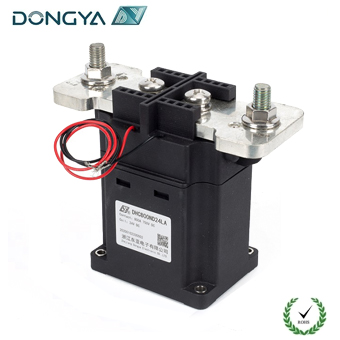
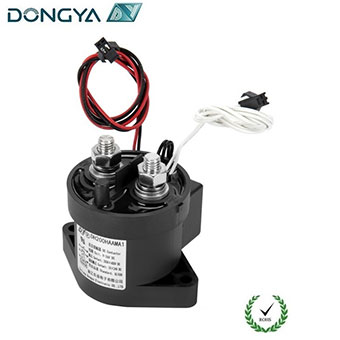
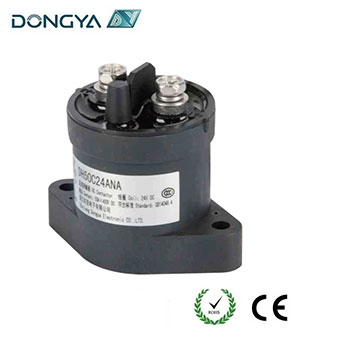
If you are sourcing components for a BDU project and want to explore configurations that meet the full checklist above, you can review Dongya’s high-voltage switching product range for detailed specifications and application support.
A BDU is only as strong as its weakest switch. In a system where failure can mean fire, the switching device inside that unit deserves more than a checkbox on a BOM. It deserves a thorough engineering evaluation grounded in real fault scenarios, realistic cycle-life requirements, and verifiable test data.
The difference between a component that passes a datasheet comparison and one that survives a 5,000-amp short circuit without welding shut is the difference between a vehicle that isolates its battery and one that does not.
GET A QUOTE