
 CN
CN EN
EN ES
ES RU
RU FR
FR AR
AR
Contact Us for All Your Needs
Our professional team will be online to provide you with the most suitable products for you.


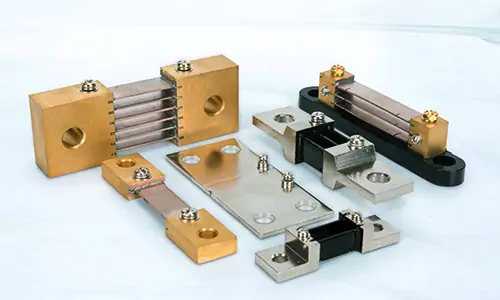
In power electronics systems that manage large DC currents, the component that measures the current must be accurate, stable over time, and immune to electromagnetic interference. A DC current sensing resistor – a precision low‑resistance element placed in series with the circuit – converts current into a measurable millivolt signal. This simple principle has been refined into a highly reliable measurement technique that now underpins some of the fastest‑growing sectors in the electrical industry.
In a battery energy storage system, the state of charge (SOC) of the battery bank must be tracked continuously and accurately. A DC current measurement element placed in the main DC bus measures the charge and discharge current in real time. The coulomb‑counting algorithm integrates this current over time to calculate the remaining capacity.
The accuracy of the SOC reading depends directly on the accuracy of the current measurement. A low‑value resistor with a low temperature coefficient of resistance (TCR) ensures that the measurement does not drift as the ambient temperature inside the battery enclosure rises during charging. Long‑term stability of the resistance value is equally critical because an energy storage system operates for years with minimal maintenance access.
For energy storage and BMS applications requiring precise current monitoring, current sensing resistors covering 1A to 2500A ratings provide the stable performance needed for accurate SOC tracking.
A DC fast charging station delivers hundreds of amps to an electric vehicle battery in a short time. The charging controller must measure the output current to regulate the charging profile and detect any overcurrent condition that could damage the vehicle battery.
A high‑current measurement resistor in the charger output must handle the full charging current continuously while keeping the temperature rise within safe limits. The element material – typically manganin, a copper‑manganese‑nickel alloy – is chosen for its low thermal EMF, meaning that temperature differences across the element do not generate spurious voltages that would corrupt the current reading.
Mechanical strength is also a consideration. The element must withstand the mechanical stress of being bolted to heavy copper busbars and must survive short‑term surge currents that can occur during connection or fault conditions. This robustness makes passive current measurement components preferable to active sensors in many charging pile designs.
Industrial inverters convert DC to AC to drive motors in pumps, compressors, conveyors, and machine tools. The inverter controller monitors the DC link current to implement overload protection, short‑circuit protection, and vector control algorithms.
A DC current measurement resistor in the DC link or in the output phase provides a direct, linear measurement of the current without the zero‑point drift that can affect Hall‑effect sensors. The linearity across the full current range means the inverter can accurately regulate motor torque from low speed to full load.
EMI immunity is a key advantage in inverter applications. The switching of IGBTs and MOSFETs generates strong electromagnetic fields that can couple into sensor electronics. A passive resistive element is inherently immune to this interference, providing a clean measurement signal even in the noisy environment inside an inverter cabinet.
Smart meters and programmable power supplies require current measurement at a level of precision that approaches laboratory standards. The current sensor must be stable over the calibration interval of the meter – typically one to two years – and must not introduce errors due to temperature variation or self‑heating.
Ultra‑low thermal EMF is a critical requirement here. When the current‑carrying element generates heat, temperature gradients across the connections can create thermocouple voltages that add to the measured signal. A measurement resistor with a very low thermal EMF against copper keeps this error negligible, ensuring that the meter or power supply maintains its accuracy class over its entire operating temperature range. For metering and precision supply designs, DC current measurement components with low thermal EMF provide the stability these applications demand.
Inside an electric vehicle, the high‑voltage DC power from the traction battery is distributed to the motor inverter, the DC‑DC converter, the cabin heater, and the air‑conditioning compressor. Each of these branches requires current monitoring for system control and fault detection.
A compact DC current measurement resistor can be integrated into the power distribution unit (PDU) of the vehicle, mounted on a busbar or PCB, depending on the current level. The element must be small and lightweight, with a low resistance value to minimise power loss and heat generation inside the sealed PDU enclosure. It must also withstand the vibration and temperature cycling that characterise the automotive environment.
In many of these applications, designers choose between a resistive current measurement element and a Hall‑effect sensor. Hall sensors provide galvanic isolation, but they introduce zero‑point drift over temperature and time, and they are more susceptible to electromagnetic interference. A passive resistive element offers several advantages: no zero‑point drift, excellent linearity, lower procurement cost, simpler peripheral circuitry, and no ageing or degradation over time. These characteristics make it the preferred choice for applications that demand long‑term stability, accuracy, and reliability.
When specifying a current measurement resistor for any of these applications, the following parameters should be checked against the circuit requirements: rated current, resistance value, accuracy class, temperature coefficient of resistance, thermal EMF, and the mechanical dimensions for busbar connection. Dongya offers a broad range of current measurement products across the SH‑F, SH‑L, SH‑T, SH‑P, and SH‑S series, covering current ratings from 1A to 2500A to suit each application’s specific requirements.
Accurate current measurement is foundational to the performance and safety of modern power electronics. In energy storage, EV charging, industrial drives, metering, and vehicle power distribution, a well‑specified DC measurement resistor delivers the stable, interference‑free signal that control systems depend on. The five applications above represent the most demanding and fastest‑growing sectors where this measurement technology is essential.
GET A QUOTE