
 CN
CN EN
EN ES
ES RU
RU FR
FR AR
AR
Contact Us for All Your Needs
Our professional team will be online to provide you with the most suitable products for you.


Coil burnout is a common failure mode that can take a high-voltage DC contactor out of service prematurely. In many cases, the root cause lies not in the coil itself but in the economizer circuit—an electronic module that reduces coil power after pull-in. Symptoms like a coil that feels abnormally hot, erratic dropout, or an open-circuit coil can all point to economizer faults. This article explains how to systematically check the economizer circuit and identify the conditions that lead to coil burnout.
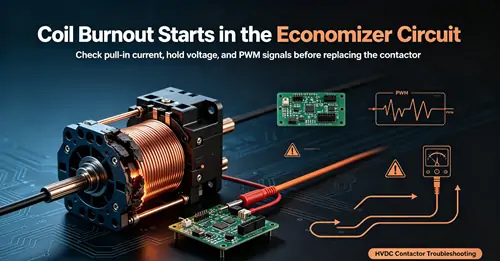
A high-voltage DC contactor typically requires a high initial current to close the contacts. Once closed, a much lower current is sufficient to keep them held. The economizer circuit (also called a coil economizer or PWM hold circuit) accomplishes this by:
• Supplying full voltage/current during pull-in for a brief period.
• Switching to a reduced average voltage (often via pulse-width modulation) to lower holding power and heat generation.
Without a functioning economizer, the coil may remain at full pull-in current indefinitely, causing overheating and eventual burnout. Failures can also occur when the economizer fails to deliver enough hold current, leading to contact chatter or dropout under vibration.
| Symptom | Possible economizer-related cause |
|---|---|
| Coil resistance is open (infinite) | Continuous overcurrent due to stuck high-current mode |
| Coil gets excessively hot during normal operation | Economizer not switching to low hold current |
| Contactor drops out unexpectedly | Economizer output interrupted; hold current too low |
| Contactor chatters or buzzes | PWM frequency mismatch or insufficient hold voltage |
| Burn marks or discoloration around coil terminals | Severe overheating from prolonged high current |
| Contactor fails to close initially | Economizer not delivering pull-in current |
Before starting, disconnect all power and ensure the contactor is safely isolated. Refer to the contactor’s datasheet for coil ratings and economizer specifications. If the manual is unavailable, you may review the technical documentation available through the product category page.
• Visual inspection: Look for damaged wiring, burnt components on the economizer PCB, or swollen capacitors. Any visible damage indicates module replacement.
• Measure coil resistance (with coil disconnected): Compare to the nominal resistance specified at ambient temperature. An open circuit points to a burnt coil; a very low resistance may suggest shorted turns.
• Check pull-in and hold voltages: Apply rated control voltage to the contactor input. Measure voltage across the coil terminals during the first second (pull-in) and then after several seconds (hold). The hold voltage should drop significantly—typically 20%–50% of the pull-in voltage, depending on design. If it remains at full voltage, the economizer is likely faulty.
• Verify hold current: Measure coil current after the economizer has stabilized. Compare with the manufacturer’s specified hold current. Excessively high current confirms the economizer is not reducing power.
• Test the PWM signal (if accessible): For modular economizers, check with an oscilloscope that the PWM signal is present and at the correct frequency and duty cycle. A missing or erratic PWM signal suggests an internal fault.
• Check input voltage stability: Ensure the control voltage supplied to the contactor is within the permitted range. Undervoltage can prevent the economizer from working correctly and cause repeated dropouts.
• Inspect coil suppression diode (if present): A failed freewheeling diode can cause voltage spikes that damage the economizer and coil.
If the economizer checks out but coils still burn out, consider these external factors:
• High ambient temperature: Operating above rated ambient may exceed the coil’s thermal class. Verify installation conditions.
• Excessive switching frequency: Rapid on-off cycling can overheat the coil, even with a working economizer.
• Control voltage spikes or transients: Use proper surge suppression.
• Incorrect contactor for the duty cycle: Continuous full-load operation beyond design may cause thermal stress. Check the rated operational current and duty type.
• Inspect coil and economizer module for signs of overheating or discoloration every 6 months.
• Measure coil resistance and compare with baseline values.
• Verify hold current is within manufacturer’s tolerance.
• Ensure control wiring is tight and free of corrosion.
• Confirm that the operating environment temperature does not exceed the contactor’s rating.
• Monitor switching frequency; if increased due to process changes, re-evaluate contactor sizing.
Q1: Can I replace just the economizer module, or must the whole contactor be changed?
If the contactor is designed with a replaceable economizer module and the main contacts are still in good condition, replacing the module may be sufficient. Many sealed high voltage units, however, integrate the economizer internally and require full replacement. Always consult the manufacturer’s service instructions or check the available configurations for your model.
Q2: How do I know if my contactor uses an economizer?
Most DC contactors with continuous coil ratings over a few watts use some form of economizer. The datasheet will list a “hold power” significantly lower than the “pull-in power.” If in doubt, measure coil current after a few seconds—if it drops, an economizer is present.
Q3: What causes the economizer to fail?
Common causes include voltage transients, capacitor aging, component overheating, and liquid ingress. Poor ventilation or high ambient temperatures accelerate failure.
Q4: Is coil burnout always an electrical problem?
Not always. Mechanical binding of the armature can prevent full closure, causing the economizer to continuously supply pull-in current and overheat the coil. Always check for smooth mechanical operation.
Q5: Can I test the coil with a multimeter only?
A resistance check can identify open or shorted coils, but it cannot verify correct economizer operation. You need to measure voltage or current under load to diagnose a failing economizer.
Most coil burnouts in high voltage DC contactors can be traced back to an economizer circuit that either stays in high-current mode or fails to hold reliably. By systematically checking pull-in and hold currents, you can pinpoint the fault before another coil fails. Always compare your measurements against the manufacturer’s specifications and operating conditions. If a replacement contactor is needed, review the product range for options that match your voltage, current, and duty requirements.
GET A QUOTE